ACT Prep
Lessons & practice tests · 3 free lessons per section, 1 free practice test per exam
ACT Prep Lessons
Master every section with our comprehensive ACT curriculum
English
15 LessonsVocabulary & Word Study
5 lessonsContext Clues
Use surrounding sentences and paragraphs to infer unknown word meanings quickly on the ACT, improving reading speed.
Patterns of Word Changes (analyze, analysis, analytical)
Identify root words and apply common prefixes and suffixes to determine meaning and part of speech of related terms.
Reference Tools & Verifying a Word’s Meaning
Select appropriate dictionaries, glossaries, or thesauruses and cross-check entries to confirm a word’s exact definition and usage.
Figures of Speech: Euphemism & Oxymoron
Spot euphemisms that soften harsh ideas and oxymorons that pair opposite terms, then explain their effect on tone.
Nuance & Word Relationships
Distinguish subtle connotations among synonyms like thin, slender, skinny, and gaunt to choose the most precise word.
Grammar, Usage & Conventions
5 lessonsParallel Structure
Construct sentences where listed ideas share the same grammatical form, ensuring clear, balanced parallel structure.
Types of Phrases
Identify and correctly use noun, verb, adjective, adverb, prepositional, gerund, and infinitive phrases to add detail without creating new sentences.
Types of Clauses
Distinguish independent from dependent clauses and apply them to combine ideas or embed supporting information within sentences.
Semicolons & Colons
Apply semicolons to link closely related independent clauses and colons to introduce lists, explanations, or quotations with precision.
Editing for Conventions
Detect and correct comma splices, run-ons, and other sentence-boundary errors while polishing spelling and punctuation.
Writing: Argument, Informative & Narrative
5 lessonsThe Writing Process: Plan, Draft, Revise, Edit
Organize ideas through planning, draft coherent paragraphs, revise for logical flow, and edit for grammar to produce polished arguments.
Argument: Precise Claims vs. Counterclaims
Craft narrow, defensible claims, support them with strong evidence, and explicitly address counterclaims to strengthen argumentative essays.
Informative/Explanatory Writing
Craft clear informative essays that organize facts, detail key points, and guide readers to understand new concepts.
Narrative Writing
Write engaging narratives that open strongly, use dialogue, pacing, and description to create a cohesive, immersive story.
Cohesion: Introductions, Transitions & Conclusions
Build cohesive pieces by linking a hook introduction, smooth transitions, and a concluding paragraph that unifies the argument.
Math
8 LessonsPre-Algebra and Number Sense Essentials
Review fractions, percents, ratios, and exponents that anchor the easier half of ACT Math.
Algebra: Linear Equations, Inequalities, and Systems
Solve for unknowns, handle inequalities, and crack two-variable systems efficiently.
Coordinate Geometry: Lines, Slope, and the Plane
Use slope, intercepts, distance, and midpoint to handle every line question on the grid.
Plane Geometry and Right-Triangle Trigonometry
Apply triangle rules, the Pythagorean theorem, area formulas, and basic SOH-CAH-TOA.
Quadratics: Factoring, the Quadratic Formula, and Parabolas
Solve quadratic equations three ways and read the key features of a parabola from its equation.
Functions, Sequences, and Logarithms
Evaluate and compose functions, handle arithmetic and geometric sequences, and apply log rules.
Trigonometry Beyond the Right Triangle: Unit Circle, Identities, and Graphs
Extend SOH-CAH-TOA to the unit circle, use core identities, and read sine and cosine graphs.
Probability, Statistics, and Counting
Compute probabilities, work with mean, median, and weighted averages, and count arrangements.
Reading
15 LessonsReading: Literature
6 lessonsCiting Strong & Thorough Textual Evidence
Select precise quotations that directly prove your claim and cite multiple examples to fully support your analysis.
Theme: How It Emerges & Is Shaped by Details (Objective Summary)
Trace a story’s theme as it evolves, showing how specific details introduce, shape, and complicate the central idea.
How Complex Characters Develop, Interact & Advance the Story
Analyze how multifaceted characters change, interact, and drive plot or theme, highlighting their conflicting motivations.
Structure, Order & Pacing: Mystery, Tension & Surprise
Identify how an author’s structural choices create mystery, tension, or surprise and explain their impact on the reader’s experience.
Point of View & Cultural Experience in World Literature
Explain how a narrator’s cultural background and point of view shape the story’s perspective and influence reader assumptions.
How Authors Draw On & Transform Source Material
Recognize the original source behind a work and describe how the author adapts it for a new purpose or audience.
Reading: Informational Text
6 lessonsCentral Idea & How It Develops Across a Text
Trace the development of a central idea throughout an informational passage and summarize how details reinforce it.
How an Author Unfolds a Series of Ideas or Events
Analyze the sequence and connections of ideas in a text to reveal how the author builds and supports an argument.
How Claims Are Developed & Refined by Particular Sentences or Sections
Examine how specific sentences or sections refine a claim, showing the role each part plays in strengthening the overall argument.
Author’s Point of View, Purpose & Rhetoric
Identify the author’s stance, purpose and persuasive tactics, then explain how word choice, appeals and structure support their goal.
Evaluating an Argument: Reasoning, Evidence & Fallacies
Assess an argument’s logic, judge the relevance and sufficiency of its evidence, and spot false statements or fallacious reasoning.
Analyzing a Seminal U.S. Document
Interpret a historic U.S. document’s core ideas, reasoning and rhetorical strategies that gave it enduring influence.
Putting It All Together
3 lessonsReading Review: Literature & Informational Text
Apply a combined toolkit to instantly recognize whether a question asks for theme analysis or evaluation of an author’s reasoning.
Language Review: Vocabulary & Grammar
Quickly pinpoint vocabulary clues and grammar rules to answer high-value ACT questions with speed and accuracy.
Writing Review: Argument, Informative & Narrative
Choose the correct writing mode for any prompt and outline the steps to craft a strong argument, explanation or narrative.
Science (optional)
7 LessonsReading Data Representations: Graphs and Tables
Extract trends and values from charts and tables quickly without prior science knowledge.
Research Summaries: Understanding Experiments
Analyze experimental design, variables, and controls across multiple related studies.
Conflicting Viewpoints: Weighing Competing Theories
Compare rival scientific explanations, find their points of disagreement, and use evidence to judge them.
Interpreting Complex Multi-Variable Data
Track relationships across multiple graphs and tables and combine data from more than one figure.
Experimental Design: Controls, Variables, and Validity
Analyze why experiments are built as they are and judge what a result does and does not show.
Conflicting Viewpoints: Mapping and Comparing Hypotheses
Dissect competing scientific explanations and pinpoint exactly where and why they disagree.
Calculations, Units, and Reasoning From Scientific Data
Perform the light math the Science section requires and reason quantitatively about trends.
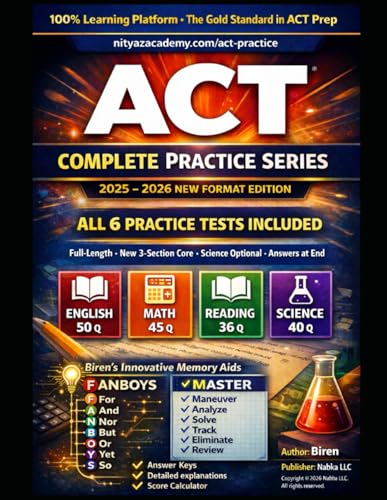
Workbooks for ACT prep
Off-screen practice from the same team, on Amazon.