SAT Prep
Lessons & practice tests · 3 free lessons per section, 1 free practice test per exam
SAT Prep Lessons
Master every topic with our comprehensive SAT curriculum
Reading & Writing
24 LessonsCraft and Structure
6 lessonsWords in Context: High-Utility Academic Vocabulary
Master Digital SAT vocabulary questions using the fill-in-the-blank method, context clues, and charge words.
Text Structure and Purpose: Analyzing Communicative Goals
Identify the primary purpose of an entire passage and analyze how the author develops arguments across paragraphs.
Author's Tone and Rhetorical Stance
Analyze the author's attitude, skepticism, neutrality, and rhetorical choices in complex passages.
Part-to-Whole Relationships: Sentence Function in Context
Determine the structural function of specific sentences or phrases within the development of an argument.
Cross-Text Connections: Synthesizing Paired Passages
Compare, contrast, and synthesize perspectives between two short texts on the same topic.
Analyzing Figurative Language and Rhetorical Devices
Interpret metaphor, imagery, understatement, and rhetorical devices in literary and historical texts.
Information and Ideas
6 lessonsCentral Ideas and Main Claims: Scope and Precision
Identify the overarching thesis of complex passages and avoid true-but-narrow detail distractors.
Explicit Factual Details: Textual Evidence and Direct Proof
Locate and verify explicit facts, mechanisms, and findings stated directly in the passage.
Command of Evidence: Textual Hypotheses and Findings
Select the textual finding, observation, or quote that most effectively supports or undermines a hypothesis.
Command of Evidence: Quantitative Data and Tables
Interpret charts, graphs, and data tables to evaluate claims and complete comparative statements.
Inferences and Logical Completions
Draw inevitable, logically conservative deductions that complete an unfinished argument.
Evaluating Arguments, Claims, and Counterclaims
Assess the validity of arguments, identify underlying assumptions, and evaluate counterevidence.
Standard English Conventions
6 lessonsSentence Boundaries: Eliminating Comma Splices and Run-ons
Master independent clauses, semicolons, coordinating conjunctions, and sentence boundary punctuation.
Semicolons, Colons, and Dashes: Rules and Uses
Master the specific structural requirements for colons, semicolons, single dashes, and paired parenthetical dashes.
Comma Rules: Essential vs. Nonessential Clauses and Appositives
Master commas with introductory clauses, appositives, nonessential modifiers, and list items.
Subject-Verb Agreement: Intervening Phrases and Collective Nouns
Ensure verbs agree in number with true subjects, ignoring prepositional phrases, parentheticals, and inverted word order.
Modifier Placement: Dangling and Misplaced Modifiers
Ensure descriptive phrases sit immediately next to the specific noun or pronoun they modify.
Parallel Structure: Lists, Comparisons, and Correlative Pairs
Maintain consistent grammatical structure across lists, comparisons, and correlative pairs.
Expression of Ideas
6 lessonsTransitions: Contrast Signals and Concessions
Select transition words that signal contrast, conflict, unexpected outcomes, and opposing viewpoints.
Transitions: Cause, Effect, and Logical Consequence
Master causal transitions including therefore, consequently, thus, and as a result.
Transitions: Addition, Elaboration, and Illustration
Differentiate between additive transitions (furthermore) and illustrative transitions (for example).
Rhetorical Synthesis: Working with Student Research Notes
Master the Digital SAT bulleted research notes questions by targeting the specific goal in the prompt.
Concision and Style: Eliminating Wordiness and Redundancy
Eliminate redundancies, wordy phrasing, and maintain formal academic register on the Digital SAT.
Digital SAT Test Strategy: Pacing, Elimination, and Pinned Answers
Synthesize section pacing (71s per question), the process of elimination, and strategic review.
Math
65 LessonsHow the Digital SAT Math Section Works
Understand the structure, the always-on calculator, the Desmos tool, and how to read student-produced response questions.
Linear Equations and Systems
Solve single linear equations and two-variable systems quickly, including word-problem setups.
Percentages, Ratios, and Data Analysis
Handle percent change, proportions, unit rates, and reading values from tables and graphs.
Quadratics and Nonlinear Functions
Factor, use the quadratic formula, interpret parabolas, and work with exponential growth.
Geometry and Right-Triangle Trigonometry
Apply area and volume formulas, circle and angle rules, the Pythagorean theorem, and SOH-CAH-TOA.
Nonlinear Systems and Points of Intersection
Solve systems mixing a line and a parabola, and reason about how many real solutions they share.
Advanced Functions: Transformations and Composition
Shift, stretch, and reflect graphs and evaluate composed functions like f(g(x)) with confidence.
Circles in the Coordinate Plane and Radian Trig
Use the circle equation, complete the square to find center and radius, and connect arcs to radians.
Statistics: Spread, Outliers, and Sampling Validity
Compare mean and median, judge standard deviation by spread, and evaluate whether a sample's conclusion is valid.
Exponents, Radicals, and Rational Expressions
Apply exponent laws, simplify radicals and rational equations, and avoid extraneous solutions.
Linear Equations in One Variable
4 lessonsSolving Linear Equations
Solve linear equations quickly by choosing steps that keep numbers small and maintain balance across the equals sign.
One Solution, No Solution, or Infinitely Many
Determine which coefficient values cause an equation to have no solution, one solution, or infinitely many solutions.
Literal Equations and Rearranging Formulas
Isolate any variable in a multi-letter equation and rearrange formulas quickly for SAT problems.
Translating Words into Linear Equations
Convert word problems into linear equations by naming unknowns first, then solve accurately on the digital SAT.
Absolute Value Equations & Inequalities
4 lessonsAbsolute Value as Distance, and Solving |A| = c
Interpret absolute value as distance and solve equations like |x|=c, finding both positive and negative solutions.
Isolating the Absolute Value First
Separate the absolute-value bars, clear outside terms, and correctly apply the two-case method to solve equations.
Absolute Value Inequalities — Bands and Rays
Translate absolute-value inequalities into interval notation, identifying bands for < and rays for > on the number line.
Absolute Value in Context — Tolerance and Error
Recognize real-world tolerance statements and rewrite them as absolute-value inequalities to solve SAT contextual questions.
Linear Functions & Rate of Change
4 lessonsFunction Notation for Linear Functions
You will be able to read and write function notation, evaluate f(a) by substitution, and translate statements like f(3)=11 into English.
Slope as a Rate of Change
You will determine a line’s slope as a unit-bearing rate, explain what a one-unit increase in x does to y, and attach correct units to your answer.
Interpreting Slope and Intercept in Context
You will interpret the meaning of the slope and y-intercept in real-world contexts, expressing each as a sentence with its appropriate unit.
Building a Linear Model from Data
You will construct the equation of a line from two data points by finding the slope, locating the starting value, and writing the final formula.
Linear Equations in Two Variables & Graphing
4 lessonsThe Coordinate Plane, Intercepts and Graphing a Line
You will locate x- and y-intercepts, plot them as points, and draw the corresponding line, understanding how each solution pair forms the graph.
Slope-Intercept Form
You will convert any linear equation to slope-intercept form, identify slope and intercept instantly, and graph the line using the y-intercept first.
Point-Slope and Standard Form
Write a line in point-slope form directly from a given slope and point, then convert it to standard form to read both intercepts instantly.
Parallel and Perpendicular Lines
Identify whether two lines are parallel or perpendicular by comparing slopes, then state their relationship without graphing.
Systems of Two Linear Equations
5 lessonsWhat a Solution Means, and Solving by Graphing
Find the exact intersection point of two linear equations by graphing them, confirming the solution satisfies both equations.
Solving by Substitution
Transform a system into a single-variable equation by isolating one variable, substitute, solve, and back-substitute for the other.
Solving by Elimination
Add or subtract equations to cancel a variable, solve the resulting single equation, then recover the eliminated variable.
No Solution, Infinitely Many, and Finding the Missing Coefficient
Determine the constant that forces a system to be inconsistent or dependent, using the proportional relationship of coefficients.
Word Problems with Two Unknowns
Set up two equations from count and measurement facts and solve the system to find both unknown quantities.
Linear Inequalities in One and Two Variables
4 lessonsSolving Linear Inequalities and the Flip Rule
Apply the flip rule correctly when multiplying or dividing an inequality by a negative number to keep the inequality true.
Compound Inequalities
Combine multiple conditions on one variable, using AND to find the overlapping region and OR to unite separate solution sets.
Linear Inequalities in Two Variables
Graph a linear inequality by deciding line style and shading the correct half-plane, then test points to confirm the region.
Systems of Inequalities and Constraint Problems
Translate real-world limits into a system of inequalities and quickly determine if a given point satisfies all constraints.
Quadratic Equations & Their Graphs
5 lessonsSolving Quadratics by Factoring
Factor a quadratic to express it as two linear terms, set each to zero, and identify the roots efficiently for the SAT.
The Quadratic Formula & the Discriminant
Determine the number and type of real roots quickly by computing the discriminant and apply the quadratic formula when needed.
Completing the Square & Vertex Form
Convert any quadratic into vertex form by completing the square, then read the vertex coordinates directly for graph questions.
Parabolas: Vertex, Axis of Symmetry & Intercepts
Identify a parabola’s opening direction, vertex, axis of symmetry, and x- and y-intercepts straight from its equation without extra conversion.
The Three Forms & Quadratic Models
Match a quadratic’s given form to specific coefficients or constants, recognizing when standard, vertex, or factored form reveals the asked feature instantly.
Polynomial Expressions & Factoring
5 lessonsOperations with Polynomials
Add, subtract, and multiply polynomial expressions accurately by aligning like terms and distributing, while correctly handling a leading minus sign.
Factoring: GCF, Grouping & Special Forms
Factor polynomials efficiently by extracting the greatest common factor first, then using grouping, special patterns, or splitting the middle term as needed.
Polynomial Division & the Remainder Theorem
Compute remainders quickly by evaluating P(a) instead of performing full polynomial division on the SAT.
Zeros, Factors & the Shape of the Graph
Identify x-intercepts, crossing or bouncing behavior, and end behavior from a factored polynomial to match or sketch its graph.
Equivalent Expressions & Polynomial Identities
Spot equivalent forms by recognizing hidden special products or factoring numerators, letting you choose the correct expression fast.
Function Notation & Transformations
5 lessonsFunction Notation & Evaluation
Evaluate f(4) or solve f(x)=4 by correctly plugging values into the function definition, avoiding common notation mix-ups.
Reading Functions from Graphs & Tables
Read values, slopes, maxima and intervals directly from a function’s graph or table, bypassing algebra for quicker SAT answers.
Composition of Functions
Compute f(g(2)) style compositions by substituting stepwise, turning nested functions into two simple evaluations on test problems.
Translations: Shifting a Graph
Shift a graph vertically or horizontally by adding or inserting numbers into the function formula.
Reflections, Stretches & Combined Transformations
Apply vertical flips, horizontal flips, and stretches to a graph and combine them in the correct order.
Exponential & Radical Functions
5 lessonsExponent Laws & Rational Exponents
Manipulate expressions with negative and fractional exponents to rewrite powers, roots, and reciprocals quickly.
Exponential Growth & Decay
Identify the initial value and growth factor in exponential models and use them to predict future quantities.
Compound Interest & Modeling with Exponentials
Convert annual interest rates to the correct compounding schedule and compute the resulting exponential growth.
Radical Expressions & Their Domains
Determine where radical expressions are defined and simplify them to their lowest terms form for answer choices.
Radical Equations & Extraneous Solutions
After working through this lesson you can isolate a square root, square both sides safely, and verify which solutions are extraneous on the SAT.
Rational Expressions & Equations
5 lessonsSimplifying Rational Expressions & Excluded Values
After completing this lesson you will factor numerators and denominators, cancel common factors, and correctly identify excluded values that remain after simplification.
Multiplying & Dividing Rational Expressions
After this lesson you can multiply and divide rational expressions by factoring, canceling across products, and tracking new denominator restrictions.
Adding & Subtracting Rational Expressions
After studying this lesson you will find the least common denominator, combine rational expressions, and apply subtraction signs to entire numerators correctly.
Solving Rational Equations
After this lesson you can clear fractions by using the least common denominator, solve the resulting polynomial, and discard any values that zero original denominators.
Rational Models: Rates, Averages & Asymptotes
After mastering this lesson you will build rational models for rates and averages, interpret asymptotes, and predict how average cost behaves as quantity changes.
Nonlinear Systems & Advanced Modeling
5 lessonsSolving Linear-Quadratic Systems
Apply substitution to solve a line-parabola system, find both x and y values, and correctly identify all intersection points.
Systems with Circles & Rational Equations
Apply substitution to solve a system containing a circle and a rational equation, then identify extraneous solutions.
Choosing the Right Model
Identify the correct function family from tables, graphs, or descriptions and select the appropriate model for any SAT problem.
Building & Interpreting Models
Create accurate variable definitions, construct a complete mathematical model from a word description, and solve it using known algebraic techniques.
Putting the Domain Together
Identify the appropriate method for any nonlinear system problem and solve it quickly under timed test conditions.
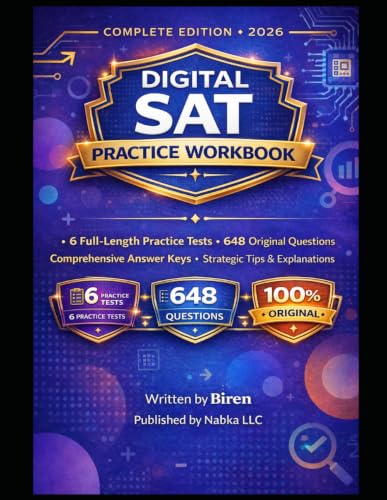
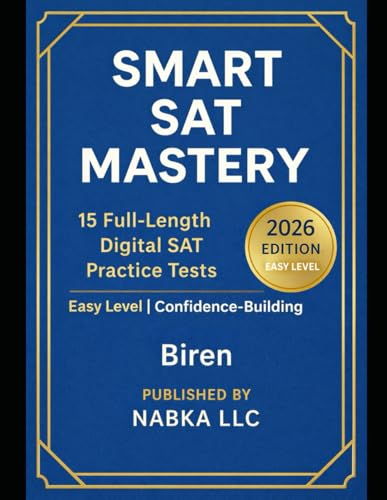
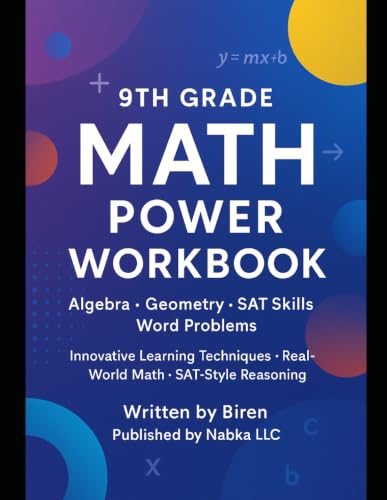
Workbooks for SAT prep
Off-screen practice from the same team, on Amazon.